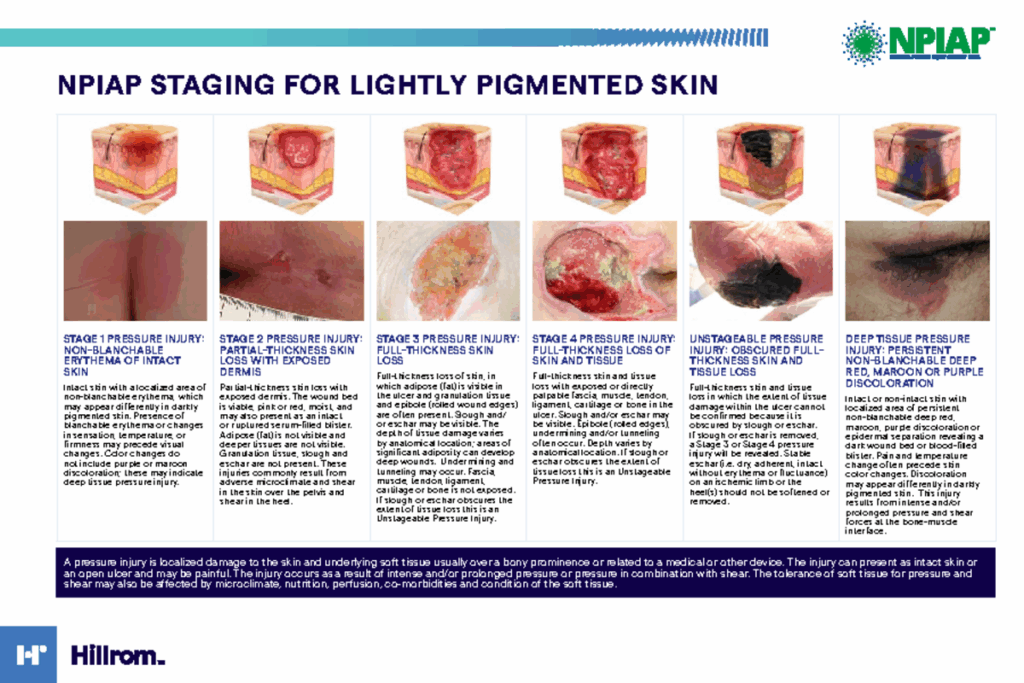
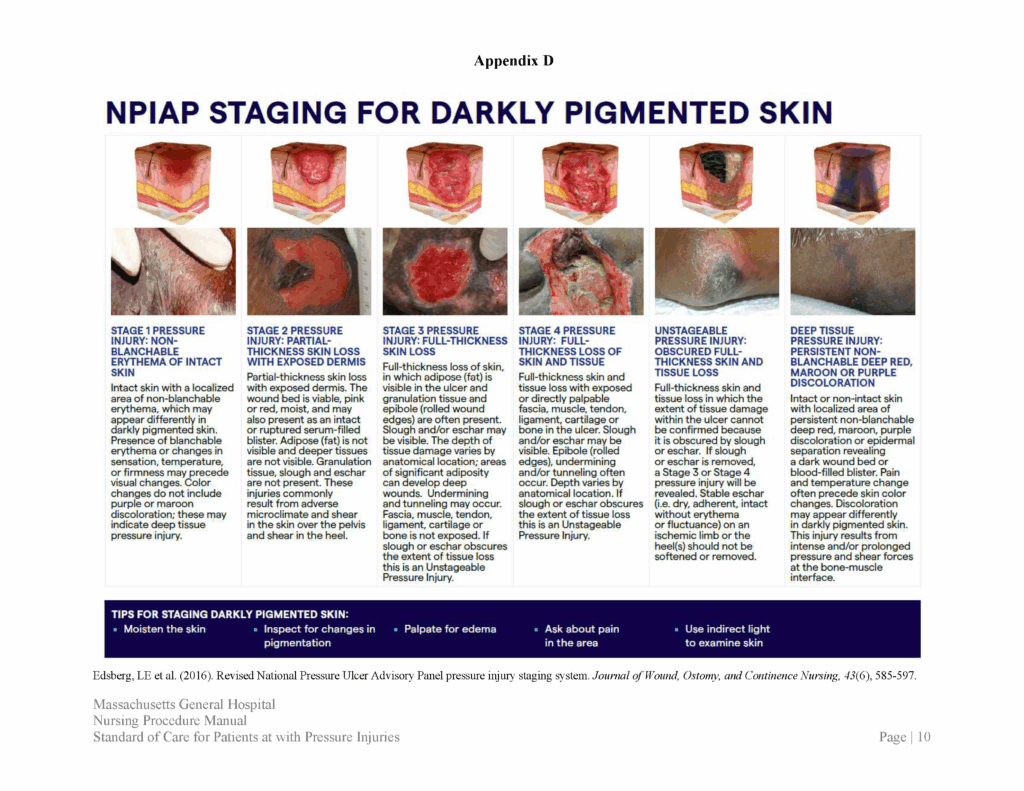
Pressure ulcers (also known as bedsores or pressure injuries) are classified into distinct stages based on the depth and severity of tissue damage. Accurate staging is crucial for guiding treatment and documenting wound progression. Below is a comprehensive guide to staging, including visual cues for each stage. For actual clinical images, refer to reputable medical resources or wound care guidelines, as direct images cannot be provided here.
Stage 1: Non-Blanchable Erythema
- Description: Intact skin with a localized area of non-blanchable redness, usually over a bony prominence. In darkly pigmented skin, the area may appear with persistent blue or purple hues and may differ in temperature, firmness, or sensation from surrounding tissue
- Visual Cues: Red or discolored patch; skin is unbroken. Pressing the area does not cause it to turn white (non-blanchable).
- Clinical Note: May be painful, firm, soft, warmer, or cooler than adjacent tissue. Early intervention can reverse this stage.
Stage 2: Partial-Thickness Skin Loss
- Description: Partial-thickness loss of dermis presenting as a shallow open ulcer with a red or pink wound bed, without slough. May also appear as an intact or ruptured blister filled with clear fluid or blood.
- Visual Cues: Shallow, open ulcer or blister. The wound bed is pink/red and moist. No visible fat or deeper tissue.
- Clinical Note: Do not confuse with skin tears, tape burns, or incontinence-associated dermatitis.
Stage 3: Full-Thickness Skin Loss
- Description: Full-thickness tissue loss. Subcutaneous fat may be visible, but bone, tendon, or muscle are NOT exposed. Slough may be present but does not obscure the depth of tissue loss. May include undermining and tunneling.
- Visual Cues: Deep crater-like wound with visible fat. Edges may be rolled (epibole). Slough (yellow/white tissue) may be present.
- Clinical Note: Depth varies by anatomical location. In areas with little subcutaneous tissue (e.g., nose, ear), ulcers may be shallow.
Stage 4: Full-Thickness Tissue Loss with Exposed Structures
- Description: Full-thickness tissue loss WITH exposed bone, tendon, or muscle. Slough or eschar may be present. Often it includes undermining and tunneling.
- Visual Cues: Very deep wound with visible muscle, tendon, or bone. May have extensive necrosis (black, dead tissue) or slough.
- Clinical Note: High risk of infection and complications. Requires urgent intervention.
Unstageable Pressure Ulcer
- Description: Full-thickness skin and tissue loss in which the base of the ulcer is covered by slough (yellow, tan, gray, green, or brown) and/or eschar (tan, brown, or black), making it impossible to determine the depth.
- Visual Cues: Wound bed obscured by necrotic tissue. True depth and stage cannot be determined until slough/eschar is removed.
Deep Tissue Pressure Injury (DTPI)
- Description: Intact or non-intact skin with localized area of persistent non-blanchable deep red, maroon, or purple discoloration. May evolve rapidly to reveal the actual extent of tissue injury.
- Visual Cues: Dark, blood-filled blister or persistent deep discoloration. Skin may feel boggy, firm, or different in temperature.
- Clinical Note: Indicates underlying soft tissue damage, often before surface breakdown becomes visible.
Summary Table: Pressure Ulcer Staging
| Stage | Depth of Injury | Key Visual Features | Tissue Exposed |
| Stage 1 | Superficial (intact skin) | Non-blanchable redness/discoloration | None |
| Stage 2 | Partial thickness (epidermis/dermis) | Shallow open ulcer or blister | None |
| Stage 3 | Full thickness (subcutaneous) | Deep crater, visible fat, possible slough | No bone/muscle/tendon |
| Stage 4 | Full thickness (deep tissue) | Exposed bone, muscle, or tendon, necrosis | Bone/muscle/tendon |
| Unstageable | Full thickness (depth unknown) | Base covered by slough/eschar | Obscured |
| DTPI | Underlying tissue damage | Deep red/purple, intact or blistered skin | Not applicable |
Note: Always assess pressure ulcers in adequate lighting and consider patient skin tone variations. When in doubt, consult a wound care specialist for accurate staging and management.